

Introduction
The U.S. Air Force is getting ready for something big. After years of speculation, rumors, and behind-the-scenes development, they’ve finally pulled back the curtain on what could be the most advanced fighter jet ever built. The Boeing F-47 just became the cornerstone of the Next Generation Air Dominance program, and honestly? It’s kind of a big deal.
Here’s the thing about the F-47 — it’s not really a replacement for anything we’ve seen before. Sure, it’s slated to eventually take over for the F-22 Raptor, but calling it a replacement feels like comparing a smartphone to a rotary phone. The F-47 sits at the center of what the Air Force calls a “family of systems,” which is just a fancy way of saying it won’t fight alone. It’ll bring friends. Drone friends, specifically.
So what makes this aircraft so special? Why should anyone outside the military aviation bubble care about another fighter jet with stealth technology and a price tag that could fund a small country’s annual budget? Well, that’s what we’re here to figure out. This article walks through what we actually know about the F-47 — its specs, its strategy, and how it plans to dominate the skies alongside a fleet of unmanned aircraft that sound like something straight out of a sci-fi movie.
The F-47 and the NGAD “Family of Systems”
More Than Just a Fighter Jet
When people hear “fighter aircraft,” they usually picture something like the F-15 Eagle or the F-16 Fighting Falcon — a single plane doing dogfight things, maybe dropping bombs, looking cool in movies. The F-47 throws that whole image out the window.
The F-47 is the manned component of something much bigger. Think of it less as a solo act and more like the quarterback of an entire football team. Surrounding this aircraft will be Collaborative Combat Aircraft — essentially drones that can fly alongside the F-47, carry weapons, gather intelligence, and even take hits so the manned jet doesn’t have to. These unmanned combat aircraft change the game completely.
The ecosystem includes advanced sensors that can see farther than anything currently in the sky, plus battle networks that connect every piece of this puzzle in real time. It’s not about building a better fighter anymore. It’s about building a better way to fight.
Where This Whole Thing Started
The NGAD program didn’t just appear overnight. The Air Force has been quietly working on this since the mid-2010s, accelerating efforts as potential adversaries started catching up in the stealth game. Here’s a fun fact that not enough people talk about: before Boeing won the contract for the F-47, the Air Force had already built and flown at least two full-scale demonstrators. Actual X-planes, not just computer models or PowerPoint presentations.
That’s pretty wild when you think about it. While the public was still focused on the F-35 Lightning II and its endless development drama, the next generation of air superiority was already being tested in secret. These demonstrators helped prove out the technologies that now form the backbone of the F-47 program.
Boeing’s Big Moment
Let’s talk about the elephant in the room: Boeing winning this contract over Lockheed Martin. For those who follow defense contracting, this was genuinely surprising. Lockheed has dominated the fifth-generation fighter space with the F-22 and F-35, and many assumed they’d continue that streak with NGAD.
But Boeing walked away with the Engineering and Manufacturing Development contract, and it’s hard to overstate what this means for the company’s defense future. After some well-publicized struggles with commercial aircraft and other defense programs, this win gives Boeing a chance to redefine itself. Skunk Works — Lockheed’s legendary advanced projects division — will have to watch from the sidelines as Boeing takes the lead on what might be the last manned fighter the Air Force ever builds.
Some industry watchers have pointed to Northrop Grumman’s earlier exit from the competition as a sign of just how complex and expensive this program would become. The company that built the B-2 Spirit apparently looked at NGAD requirements and decided the juice wasn’t worth the squeeze. That tells you something about the scale of what Boeing just signed up for.
Key Specifications and Advanced Capabilities
Range That Changes Everything
One of the most impressive numbers floating around about the F-47 is its combat radius: over 1,000 nautical miles. That’s roughly 1,852 kilometers for those keeping score at home. To put that in perspective, most current fighters need frequent tanker support to operate across the vast distances of the Indo-Pacific theater. The F-47 can get there, do its job, and come back without begging for gas along the way.
This extended range isn’t just a nice feature — it’s a strategic requirement. The Pacific Ocean is really, really big, and the network of tanker aircraft that current fighters depend on would become prime targets in any major conflict. By building an air superiority fighter that can go the distance on its own, the Air Force reduces vulnerability and simplifies logistics. Pretty smart, honestly.
Stealth That Makes the F-22 Look Old
The F-22 Raptor has been the gold standard for stealth since it entered service. The F-35 improved on some aspects but made trade-offs for its multirole capabilities. The F-47? It’s aiming for something the Air Force officially calls “Stealth++.”
Here’s the breakdown they’ve hinted at: the F-35 represents baseline “Stealth.” The F-22 achieved “Stealth+.” The F-47 targets “Stealth++,” which basically means it’s designed to remain invisible against advanced air defenses that might actually be able to detect current stealth aircraft. China and Russia have spent the last twenty years building radar systems specifically meant to counter American stealth technology. The F-47 is the answer to that.
This level of stealth technology doesn’t come cheap or easy. It affects everything from the aircraft’s shape to the materials used in its skin. Every curve, every edge, every panel has to be perfect. And with the F-47, Boeing is pushing that science further than anyone has before.
Performance Numbers Worth Noticing
Speed still matters in air combat, even with all the focus on stealth and sensors. The F-47 is expected to exceed Mach 2 at altitude, which puts it in the same neighborhood as previous generation fighters. But the real story is sustained supersonic cruise — the ability to fly at high speeds for long periods without engaging afterburners and draining fuel tanks.
This “supercruise” capability, combined with that massive range, means the F-47 can patrol huge areas at high speed, respond to threats quickly, and maintain energy advantage when things get hot. It’s the kind of performance that pilots dream about and adversaries worry about.
A Peek at the Design
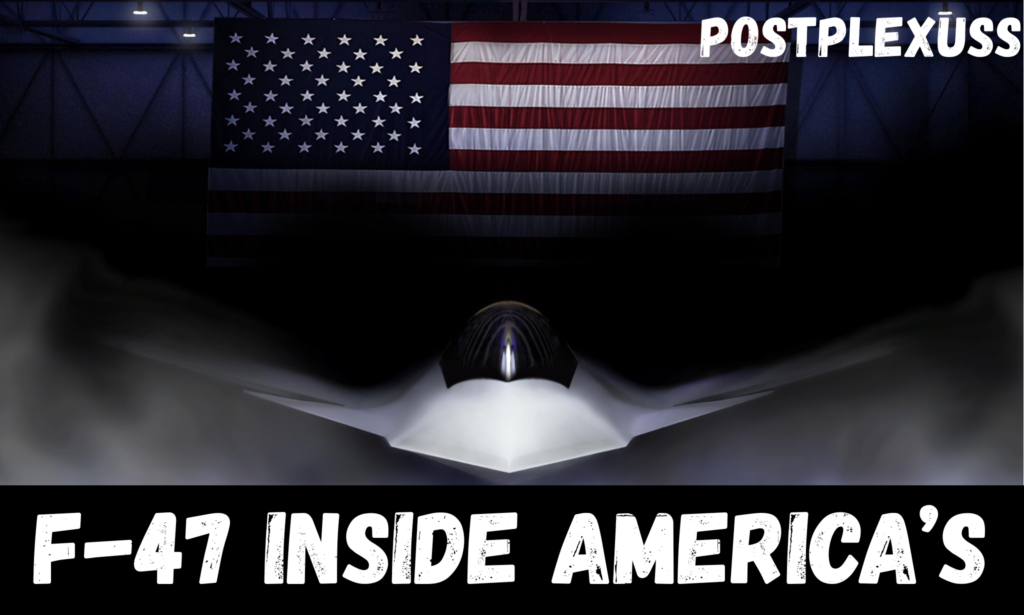
Boeing hasn’t shown much of the actual F-47 yet. The official renderings are carefully obscured, revealing just enough to generate interest without giving away classified details. What we can see includes a fairly unique wing design with high dihedral — the wings angle upward from the fuselage — and what appears to be canard foreplanes near the cockpit.
These design choices tell aerodynamicists a lot about how the aircraft might fly. Canards typically indicate a focus on maneuverability, allowing the jet to pull high angles of attack without losing control. The wing configuration suggests stability and efficiency at both high and low speeds. It’s a fascinating glimpse at an aircraft that most of us won’t see in person for years, if ever.
The “Quarterback” of the Skies: Human-Machine Teaming
Leading the Drone Pack
Here’s where the F-47 really separates itself from everything that came before. This aircraft isn’t designed to fight alone. It’s built to command.
The Collaborative Combat Aircraft concept has been floating around defense circles for years, but the F-47 makes it real. These drones — currently designated YFQ-42A and YFQ-44A — will fly alongside the manned jet, extending its sensors, carrying extra weapons, and even acting as decoys to draw enemy fire. The F-47 pilot becomes less of a lone wolf and more of a mission commander, directing unmanned teammates like a chess player moving pieces across the board.
The Air Force plans to acquire over 1,000 of these Collaborative Combat Aircraft. Think about that number for a second. The F-47 production run itself might top out around 185 aircraft, but each one could be accompanied by multiple drones. That’s a massive shift in how air power gets applied.
How Teaming Changes Combat
Picture this: an F-47 approaches enemy airspace. Instead of flying straight in, it sends a drone ahead to scout. That drone detects a surface-to-air missile site and relays the coordinates back. The F-47 stays safely outside engagement range while another drone, carrying air-to-ground weapons, moves in to eliminate the threat. Meanwhile, a third drone flies a diversionary route, appearing on enemy radar as a potential target and drawing attention away from the real action.
None of this requires the pilot to multitask excessively. The systems handle the coordination, with the pilot making high-level decisions about priorities and rules of engagement. It’s force multiplication in the truest sense — one pilot plus multiple drones equals more capability than several manned fighters could provide on their own.
This isn’t science fiction. The technology exists, and the F-47 is being built from the ground up to exploit it. Previous fighters have had to adapt to drone control as an afterthought. The F-47 treats it as a core requirement.
Strategic Role and Future Deployment
Built for One Job
Unlike the F-35 Lightning II, which tries to be everything to everyone — air-to-air combat, ground attack, electronic warfare, intelligence gathering — the F-47 focuses on one thing: air superiority in highly contested environments.
That might sound limited, but it’s actually incredibly important. When the Air Force needs to operate where enemy air defenses are strongest and enemy fighters are most capable, the F-47 is the tool for the job. It punches holes in enemy defenses, clears the sky of threats, and creates safe corridors for other aircraft to operate. It’s the tip of the spear, not the entire spear itself.
This specialization explains some of the design choices. The extreme stealth, the long range, the drone coordination — all of these support the primary mission of establishing air dominance when and where it matters most.
Saying Goodbye to the Raptor
The F-22 Raptor has served since 2005 as the world’s premier air superiority fighter. It’s never been defeated in combat, never faced a serious challenge from any adversary aircraft. But technology moves forward, and the F-22’s design dates to the 1990s. Its avionics, while still capable, can’t easily integrate with modern battle networks. Its stealth, once revolutionary, faces threats from new detection systems.
The F-47 will begin replacing the F-22 fleet in the 2030s. The plan calls for at least 185 aircraft, which would make it a relatively small fleet by historical standards — the F-15 Eagle saw over 1,500 built across all variants. But quality matters more than quantity when each F-47 brings along its own team of drones. The math works differently now.
Timeline to Reality
Assuming the program stays on schedule — always a risky assumption with advanced aircraft development — the first F-47 should fly around 2028. Initial operational capability, meaning the first squadron ready for actual combat missions, should follow in the early 2030s.
That timeline gives Boeing room to work through the inevitable challenges of building something this complex. It also gives the Air Force time to develop tactics, train pilots, and integrate the drone fleet. By the time the F-47 reaches operational status, the whole system should be ready to deliver on its promises.
Challenges and the Road Ahead
The Cost Question
Let’s be real for a minute: the F-47 is going to be expensive. Really expensive. Each aircraft will likely cost several hundred million dollars when you factor in development, production, and the drones that come with it. Even with a production run of around 185 aircraft, the total program cost will probably exceed $100 billion over its lifetime.
That kind of money raises legitimate questions. Is this the best use of defense dollars? Could the same mission be accomplished with different technology? Should the Air Force invest more in unmanned systems and less in manned fighters?
These aren’t easy questions, and the answers depend on assumptions about future threats and technological developments. What’s clear is that the F-47 represents a massive bet on the continued relevance of manned aircraft in an increasingly unmanned world.
Technical Hurdles
Boeing faces significant technical challenges in delivering the F-47 on time and on budget. The company has struggled with other major programs, and the F-47 will face intense scrutiny from Congress, the Pentagon, and the public. Every delay, every cost overrun, every technical problem will make headlines.
The stealth technology alone pushes the boundaries of what’s possible. The battle networks require flawless integration across multiple platforms. The drone coordination systems must work reliably in combat conditions with zero room for error. It’s a lot to ask of any company, even one with Boeing’s experience and resources.
Why This Matters Now
The F-47 doesn’t exist in a vacuum. It’s a direct response to the growing capabilities of potential adversaries, particularly China and Russia. Both countries have invested heavily in advanced air defenses and next-generation fighters. The era of uncontested American air superiority, which lasted roughly from 1991 to the present, is ending.
The F-47 aims to restore that advantage, or at least maintain parity in an increasingly competitive environment. Its success or failure will shape global military balance for decades. That’s a lot of weight to put on one aircraft program, but that’s where things stand.
Conclusion
The F-47 represents something genuinely new in military aviation. Not just because of its stealth or range or speed, though those matter. What makes it different is the shift from thinking about individual fighters to thinking about systems of systems. The F-47 alone is impressive. The F-47 surrounded by loyal wingman drones, connected to advanced sensors, integrated into battle networks — that’s something else entirely.
Will it work? That depends on Boeing’s execution, on the Air Force’s willingness to adapt its tactics and culture, on the evolution of threats over the next twenty years. But for now, the vision is clear: a manned quarterback leading a team of unmanned players, dominating the sky through coordination rather than just individual excellence.
The F-22 Raptor defined air superiority for a generation. The F-47 aims to define it for the next one. Whether it succeeds or not, the attempt itself tells us something about where air combat is heading. And honestly? It’s going to be fascinating to watch.