

Introduction
A Chinese sword is far more than a sharpened blade. It carries centuries of memory, craftsmanship, discipline, and symbolism. When people picture an ancient Chinese sword, they often imagine warriors in flowing robes, martial artists moving with quiet precision, or imperial guards standing in silent formation. And they wouldn’t be wrong.
The traditional Chinese sword has played a central role in shaping Chinese history. It appears in battlefield records, poetry, folklore, and martial arts schools across generations. As one of the most respected ancient Chinese weapons, it reflects not only combat technique but also philosophy and culture.
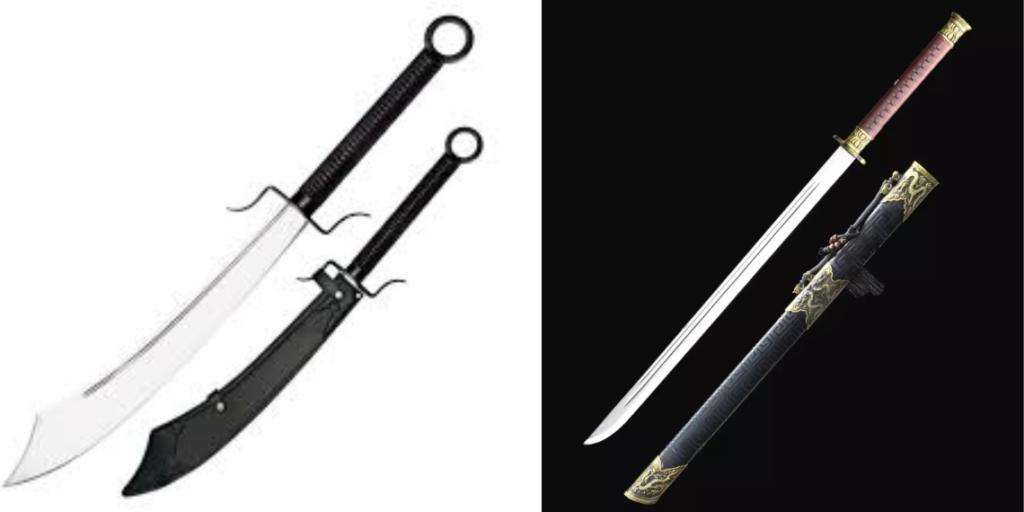
There are many Chinese sword types, but two stand above the rest: the Jian and the Dao. One is elegant and straight. The other is curved and forceful. Together, they define the story of the sword of ancient China.
History of the Chinese Sword
Origins in Ancient China
The story of the Chinese sword weapon begins thousands of years ago. Early bronze blades appeared during the Shang period, marking the rise of organized warfare in early Chinese civilization. These early forms were simple compared to what came later, but they laid the foundation for what would evolve into refined Chinese steel sword designs.
As metalworking improved, swords became stronger, sharper, and more reliable. By the time iron and steel replaced bronze, the blade was no longer just a tool of survival. It became a symbol of status and authority.
In many ways, the authentic Chinese sword represented discipline. A warrior did not simply carry it; he trained with it, respected it, and in many traditions, bonded with it.
Evolution Through Major Dynasties
During the Han era, the straight blade gained popularity. Later, the Tang dynasty sword emerged as a powerful military weapon, reflecting China’s expanding influence and organized armies. The Tang dynasty sword was balanced, practical, and suited to cavalry combat.
By the Ming period, battlefield demands shifted. The Ming dynasty sword often included curved variations that improved cutting power. These designs would influence later forms, especially those used by infantry soldiers.
The Qing dynasty sword continued that evolution. The Qing dynasty sword often featured refined fittings and ornate details, especially in imperial courts. These were not just Chinese battlefield weapons — they were imperial Chinese weapons meant to display authority and rank.
Across each dynasty, design changes reflected real-world needs. War strategies changed. Armor improved. Combat styles evolved. The sword adapted every time.
Role in Warfare and Martial Arts
On the battlefield, swords were reliable sidearms. Spears and polearms often dominated open combat, but when formations broke or fighting closed in, the Chinese warrior sword came into its own.
Outside war, the sword found another life — in discipline and art. Monasteries and martial arts schools preserved techniques long after certain weapons faded from active military use. The blade became central in training systems that are still practiced today.
This transition helped protect traditional Chinese craftsmanship. Swordsmiths continued forging blades not just for war, but for mastery and performance.
Main Types of Chinese Swords
While many variations exist, most discussions return to two primary forms: Jian and Dao. Each carries its own personality.
3.1 Jian (Chinese Straight Sword)
The Jian is often described as the Chinese straight sword. With its double-edged design, it looks symmetrical and refined. Yet beneath that elegance lies precision and control.
Because of its balance and versatility, the Jian earned the title “Gentleman of Weapons.” That name says a lot. It suggests restraint. Skill. A certain level of education and refinement. Historically, scholars and nobles favored the Jian as much as warriors did.
Unlike heavier blades designed purely for cutting, the Jian allowed both slashing and thrusting. Its movements in martial arts appear fluid and deliberate. It rewards technique over brute force.
In many modern schools, the Wushu sword seen in competitions is based on the Jian. Practitioners of Tai Chi also train with this blade, focusing on smooth, connected movement. A kung fu sword routine featuring the Jian often looks almost like a dance — controlled yet powerful.
The Jian’s role in Chinese sword symbolism cannot be overlooked. It often represents virtue, balance, and moral strength. In literature and folklore, heroes frequently carry a Jian rather than a heavier saber.
Even today, collectors seek a handmade Chinese sword modeled after historical Jian designs. A well-crafted version showcases detailed fittings, careful blade balance, and polished scabbards.
3.2 Dao (Chinese Broadsword)
If the Jian is graceful, the Dao is direct.
The Dao, commonly referred to as the Chinese broadsword or Chinese saber sword, features a single-edged curved blade. That curve makes it ideal for powerful slashing movements. On the battlefield, speed and force matter — and the Dao delivered both.
Many soldiers favored the Dao because it was practical and forgiving in combat. It required less delicate precision than the Jian and could handle heavy strikes. For infantry units, it became one of the most dependable Chinese battlefield weapons.
There are several important variations:
- Dadao – A large, heavy blade often used in later military history.
- Liuyedao – Known as the “willow leaf saber,” with a gentle curve and balanced handling.
- Yanmaodao – A hybrid form that blends straight and curved characteristics.
Each variation reflects specific tactical needs.
In martial arts training, the Shaolin sword curriculum frequently includes Dao forms. These routines emphasize explosive power and decisive movement. A Chinese martial arts sword demonstration featuring the Dao feels energetic and grounded.
Because of its historical use, many people associate the Dao with frontline soldiers and seasoned fighters. It carries a rugged personality compared to the refined Jian.
Craftsmanship and Cultural Meaning
Beyond combat, what truly defines the Chinese sword is the craftsmanship behind it.
Traditional Chinese craftsmanship values balance — not just in handling, but in design harmony. Blade, guard, handle, and scabbard must complement one another. High-quality Chinese steel sword construction involves careful forging, controlled heating, and repeated shaping.
An authentic Chinese sword isn’t rushed. Historically, smiths spent days or even weeks perfecting a single blade. Decorative carvings, dragon motifs, and engraved fittings reflected status and symbolism.
Chinese sword symbolism often connects the blade to justice, protection, and honor. In some traditions, swords were believed to ward off negative forces. In others, they represented scholarly discipline as much as combat readiness.
Collectors today look for details that echo the sword of ancient China — proper balance, historically accurate fittings, and attention to period design. Whether modeled after a Ming dynasty sword or inspired by earlier forms, quality still matters.
The Enduring Legacy
The Chinese sword has survived not only because it was effective, but because it adapted. From imperial Chinese weapons carried in royal courts to training tools in modern martial arts schools, its identity continues to evolve.
Some admire it for its beauty. Others for its practicality. Many are drawn to the stories behind it — warriors, monks, generals, and masters who trained with discipline and purpose.
What remains consistent is the respect it commands. Whether one studies Chinese sword types academically, practices with a Wushu sword, or collects a Chinese warrior sword for display, the connection to history feels tangible.
Blades may no longer dominate modern battlefields, but their cultural weight hasn’t faded. The legacy of the ancient Chinese sword still stands — balanced, sharp, and deeply rooted in tradition.



Pingback: Sluice Gate: Types, Working Principle, and Applications in Modern Water Control - PostPlexuss