
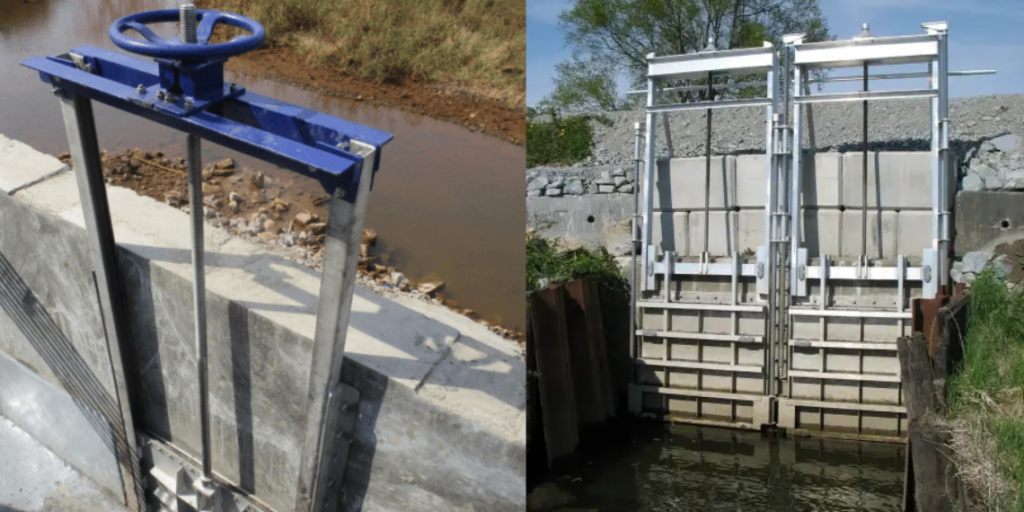

Introduction to Sluice Gate
Water has always needed direction. Whether it’s guiding irrigation across farmland or controlling river discharge at a dam, managing flow is never accidental. That’s where a sluice gate steps in.
A sluice gate is a mechanical device designed to control water flow in a water control structure. It acts as a movable barrier that can raise, lower, or regulate the movement of water through a channel or opening. Simple in concept, yet essential in practice.
Its purpose within water management systems is straightforward: control, regulate, and sometimes completely stop water flow. From preventing floods to maintaining steady irrigation levels, a properly installed water sluice gate ensures stability where it matters most.
They are commonly found in dams, canals, wastewater facilities, reservoirs, and agricultural systems. In large infrastructure projects, a dam sluice gate or spillway gate plays a critical role in protecting downstream areas. Meanwhile, a canal sluice gate quietly manages irrigation channels in farming regions.
In short, it’s one of those systems most people never notice—until it fails.
How a Sluice Gate Works
At its core, the working principle of a sluice gate revolves around vertical or radial movement. The gate lifts or lowers to adjust the opening size, which directly controls the volume and speed of water passing through.
When the gate rises, water flows underneath. When it lowers, flow reduces or stops. That movement forms the basis of a flow regulation system.
Basic Working Principle
Water pressure pushes against the gate surface. By adjusting the opening height, operators can regulate discharge rates. In some setups, especially high-pressure environments, a hydraulic sluice gate is used for smoother and more controlled operation.
The engineering may look simple from the outside, but internally, several components work together.
Core Components of a Sluice Gate
Every functional sluice gate relies on carefully designed parts:
- Gate frame assembly – The structural support that holds the gate securely in position.
- Embedded gate frame – Installed within a reinforced concrete channel or wall for long-term durability.
- Stainless steel gate plate – Often used in a steel sluice gate for strength and corrosion resistance.
- Rubber seal gasket – Prevents leakage when the gate is fully closed.
- Guide channel system – Ensures smooth vertical movement without misalignment.
- Lifting spindle – Transfers mechanical motion to raise or lower the gate.
- Gate hoist mechanism – The driving system that controls movement.
- Gearbox hoist – Used for larger gates requiring mechanical advantage.
- Control panel system – Found in automated installations.
- Corrosion-resistant coating – Extends lifespan in harsh water environments.
Each part may seem minor on its own. Together, they form a reliable barrier capable of handling immense pressure.
Manual vs Hydraulic Operation
Operation methods vary depending on project size and budget.
A manual sluice gate uses a handwheel or mechanical hoist. It’s commonly seen in smaller irrigation systems where simplicity is preferred.
On the other hand, a hydraulic actuator gate relies on pressurized fluid systems for movement. This approach allows precision control, particularly in large-scale dams and flood zones.
Automation also introduces electrical systems and monitoring panels, allowing remote operation when needed.
Main Types of Sluice Gates
Not all sluice gates are built the same. Different environments demand different designs.
Vertical Lift Sluice Gate
A vertical lift gate moves straight up and down within guide channels. It’s one of the most widely used designs due to its simplicity and reliability. This type is commonly installed in canals and reservoirs.
Because of its straightforward design, it integrates easily with a slide gate system and works efficiently in medium-pressure conditions.
Radial (Tainter) Gate
Also known as a radial gate, this curved design rotates on hinges rather than lifting vertically. The curved surface helps distribute water pressure more evenly.
It’s frequently used as a flood control gate or spillway gate in dams where managing high-volume discharge is critical.
The radial configuration reduces structural stress, which makes it ideal for large openings.
Slide Gate
A slide gate system typically refers to a flat plate that moves within grooves to control flow. While sometimes used interchangeably with vertical lift systems, slide gates are often applied in wastewater facilities and treatment plants.
They are compact, effective, and relatively easy to maintain.
Flap Gate
Flap gates operate differently. They open automatically when upstream pressure exceeds downstream pressure and close when flow reverses.
These gates are often installed in drainage systems to prevent backflow. In coastal areas, they protect inland water networks from rising tides.
Automated Sluice Gate Systems
Automation has reshaped water management. An automated sluice gate valve system integrates sensors, electric motors, and a control panel system for real-time adjustments.
These systems are frequently used in large irrigation projects and hydro facilities. For example, an irrigation sluice gate connected to moisture monitoring equipment can adjust flow automatically depending on field requirements.
It reduces human intervention and improves precision—something traditional systems simply couldn’t offer.
Where Sluice Gates Are Commonly Used
Sluice gates serve a wide range of applications.
In dam projects, a dam sluice gate controls reservoir discharge. Sometimes it works alongside a penstock gate, directing water toward turbines in hydroelectric systems.
In agricultural networks, a canal sluice gate regulates water levels across multiple branches. A well-installed weir gate system may also be used to maintain upstream depth.
Municipal wastewater plants rely on controlled gate movement to manage treatment stages.
And in flood-prone regions, a properly engineered flood control gate can mean the difference between safety and severe damage.
Final Thoughts
A sluice gat may look like a simple sliding panel, but behind that panel sits careful engineering, layered safety systems, and decades of refinement.From a basic manual sluice ate installed in a rural canal to a fully automated hydraulic sluice ate guarding a massive dam, the principle remains consistent: control the water, protect the system.


Pingback: Jesus Wept: The Shortest Verse in the Bible with the Deepest Meaning - PostPlexuss